

A Salvific Foreshadowing
A Scriptural Analysis of the Wedding Feast at Cana

The following “letter” is an excerpt from one of my undergraduate papers. It is denser than my previous letters, exploring the theology and especially the Mariology found in the Wedding Feast at Cana. I hope in the future to publish more pieces like this, as the theology concerning Our Lady, especially as found in Scripture, is the starting point for all love and devotion to her.
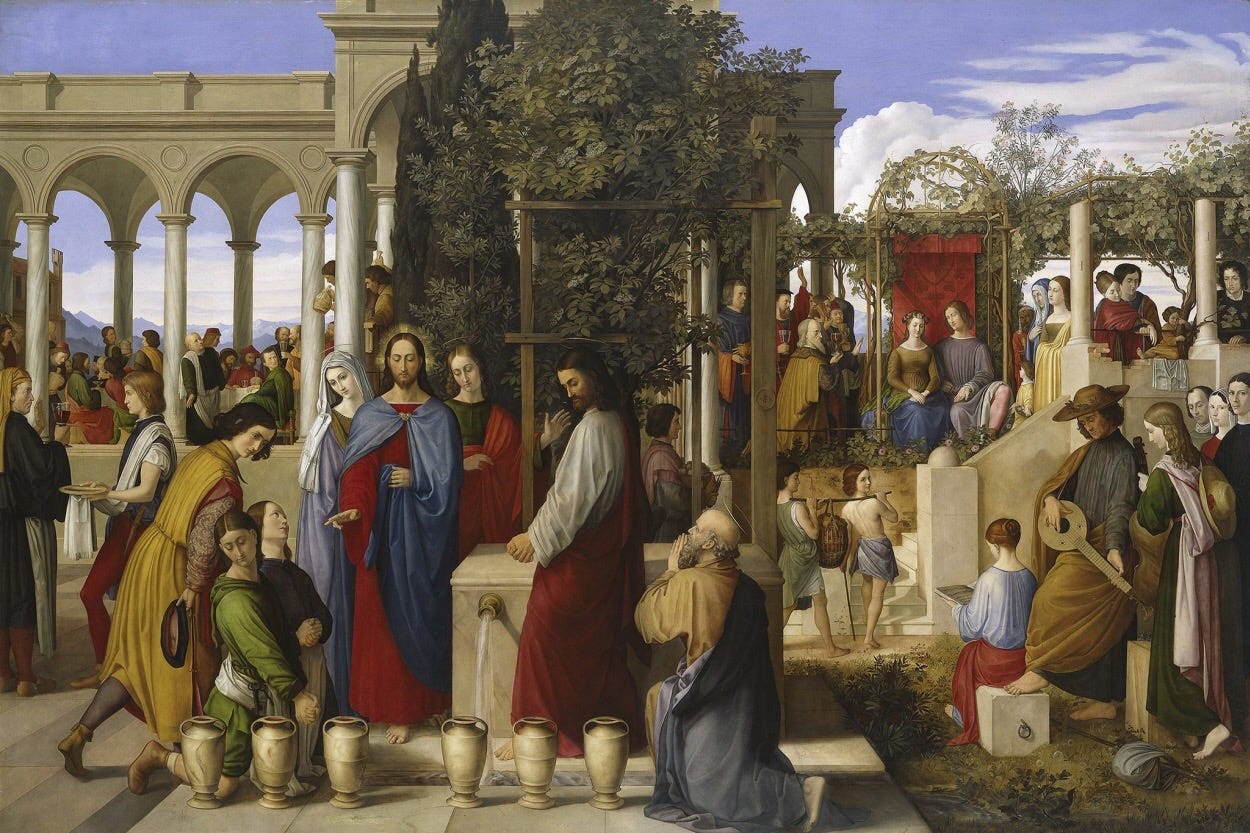

Sacred Scripture contains many layers, and a superficial reading misses the theological depth hidden in its words. This is especially the case in the Gospel of John, where Jesus “uses ordinary words [and concepts] in a manner charged with different layers of meaning.”[1] A careful reading of any scene from John’s Gospel, illuminated by references to the Old Testament and other places of the New Testament, unveils a richer understanding of Jesus and his mission. One such passage is the famous Wedding Feast at Cana, where Jesus transforms water into wine. It is the first of seven or eight signs which Jesus performs to elicit belief in his followers,[2] and the first public manifestation of his glory. (cf. Jn 2:11, RSV) The initial revelation of Jesus at the Wedding Feast holds no small significance when investigated more deeply. In the Gospel of John, the Wedding Feast at Cana highlights Mary’s role in salvation, the “hour” of Jesus, and three motifs that ultimately foreshadow Christ’s salvific mission.1
Mary’s Role
The beginning of the Wedding Feast at Cana introduces Mary and symbolically points toward her role in her Son’s work of salvation. Especially important in this passage are her actions as intercessor and her title of “woman.” The words pertaining to her begin with John 2:1 and ends at 2:5:
On the third day there was a marriage at Cana in Galilee, and the mother of Jesus was there; Jesus also was invited to the marriage, with his disciples. When the wine failed, the mother of Jesus aid to him, “They have no wine.” And Jesus said to her, “O woman, what have you to do with me? My hour has not yet come.” His mother said to the servants, “Do whatever he tells you.” (Jn 2:1-5)
Mary’s appearance at the first public manifestation of Jesus is of no small consequence. In the Gospel of John, Mary is only named twice: at the Wedding at Cana, and at the foot of the Cross in chapter nineteen.[3] The second time, Jesus gives his mother to St. John during the final moments of his life: “When Jesus saw his mother, and the disciple whom he loved standing near, he said to his mother, ‘Woman, behold, your son!’” (Jn 19:26). That Mary is present at the beginning and the end of Jesus’ salvific mission stresses the importance of her role in both circumstances as intercessor and “the woman,” the New Eve.
The symbolic events at the Wedding begin with Mary noticing the new couple has run out of wine: “When the wine failed…” (Jn 2:3) In Ancient Israel, to have the wine fail at a wedding could bring “shame, or spite to the hosting family (the groom’s family).”[4] Mary foreshadows her future role as intercessor by presenting the people’s needs to Jesus,[5] not by a question, but by pointing out a reality: “…the mother of Jesus aid to him, ‘They have no wine.’”
Jesus’ response to Mary’s compassionate request at first appears rude and negative: “And Jesus said to her, ‘O woman, what have you to do with me? My hour has not yet come.’” (Jn 2:4) While the title “woman” might seem derogatory to modern ears, in the typical ancient Jewish cultural context, “‘woman’ is a polite and dignified way of addressing a woman.”[6] However, “it was not a form of address for one’s own mother.”[7] The puzzling title is made clear by recalling the Protoevangelium in Genesis 3:15, in which Christ’s redemptive work is foretold: “I will put enmity between you and the woman, and between your seed and her seed; he shall bruise your head, and you shall bruise his heel.” Thus, “calling his mother ‘woman,’ …was Jesus particularly identifying Mary as the woman of Genesis (3:15), honoring and reminding her of her role as the New Eve, mother whose Son will fulfill the prophecy of Genesis…”[8] Jesus calls his mother by this title “woman” both at this beginning of his public ministry and at the end,[9] connecting the events and Mary’s identity as the New Eve in both circumstances.
Following Jesus’ address of Mary under the title of “woman,” he cryptically says, “‘…what have you to do with me? My hour has not yet come.’” (Jn 2:4) The first part, ““What have you to do with me? What is that to you or me? … implies a divergence of view, the precise meaning is to be determined by the context, which shows that it is not an unqualified refusal...”[10] A more specific interpretation is given by Venerable Fulton Sheen:
Our Lord was saying to His Blessed Mother: “My dear Mother, do you realize that you are asking me to proclaim my Divinity, to appear before the world as the Son of God, and to prove my Divinity by my works and my miracles? …My hour is not yet come; but would you have me anticipate it? Is it your will that I go to the Cross?” …Our Blessed Lord was presenting to Mary not merely the choice of asking for a miracle or not; rather He was asking if she would send Him to His death. …The answer of Mary was one ofcomplete cooperation in the Redemption of Our Blessed Lord…[11]
Mary cooperates with the difficult will of God for man’s salvation, undoing Eve’s disobedience.[12] This is manifest through her entire life, and is particularly notable at the Wedding Feast at Cana. There, Mary has full trust in how Jesus will handle the lack of wine, as she tells the servants, “Do whatever he tells you.” (Jn 2:5) “In her instruction, Mary not only shows her total confidence in Jesus; she equally in a most perfect and complete manner reverses the human estrangement from God which defined the fall of man, and thus, makes it a model of instruction and mission.”[13]
Mary’s handling of the lack of wine thus prefigures her role as intercessor and New Eve: she presents the people’s needs to her son, and then surrenders to him in complete obedience. Later in the age of the Church, she will continue presenting her children’s needs to her Son, and always follow his will as she did at Cana and Calvary.
[1] Scott M. Lewis, The Gospel According to John and the Johannine Letters (Order of St. Benedict: Collegeville, Minnesota, 2005), 5.
[2] Felix Just, “‘Signs’ in the Fourth Gospel,” at Catholic Resources (26 March 2022), at www.catholic-resources.org.
[3] Francis Martin and William M. Wright IV, The Gospel of John: Catholic Commentary on Sacred Scripture (Baker Publishing Group: Grand Rapids, MI, 2015), 57.
[4] Kizito Uzoma Ndugbu, Augustina Ngozi Ndugbu, & Ihembu Mary Ijechukwu, “The Wedding Feast at Cana: A Mariophany of the Mother of Mercy (John 2:1-11),” Journal of Biblical Theology, 4 no. 3 (2021), 222.
[5] Ndugbu, “The Wedding Feast at Cana,” 224.
[6] Ndugbu, “The Wedding Feast at Cana,” 224.
[7] Martin and Wright, The Gospel of John, 57.
[8] Ndugbu, “The Wedding Feast at Cana,” 225.
[9] Ndugbu, “The Wedding Feast at Cana,” 225.
[10] The Holy Bible: Revised Standard Version Second Catholic Edition (West Chester, PA: Ascension, 2018), 1384.
[11] Fulton J. Sheen, The World’s First Love: Mary, Mother of God (San Francisco: Ignatius Press, 2011), 118-119.
[12] Catechism of the Catholic Church, 2nd ed. (Washington, DC: United States Catholic Conference, 2000), 411.
[13] Ndugbu, “The Wedding Feast at Cana,” 228.
The “hour” of Jesus and the three motifs are discussed in the rest of my paper, which is not published here.
We have a song called, "Do What He Tells You to Do" which also refers to the First Miracle.